Discontinuous or Interrupted Projections like the Butterfly Map are certainly exotic. But does that also mean that there are no open source GIS supporting them?

Butterfly Map example

This question on gis.stackexchange.com is awaiting an answer :)

Update:

Using Generic Mapping Tools (GMT) it seems relatively easy to create a map showing an Interrupted Sinusoidal Projection. Here’s an example out of their manual (PDF, page 121):

World map using the Interrupted Sinusoidal projection

World map using the Interrupted Sinusoidal projection
For all of us who couldn’t attend FOSS4G in Barcelona this year there are some of the great workshops available online:

You can call almost any function in Python, using “grass.run_command(“function”, ….)”.

For your inspiration, you find GRASS Python scripts in their SVN.

Great news everyone: Since revision r14172, QGIS supports non-spatial tables! This means you can finally load your CSV files directly into QGIS and work with them, e.g. use “Join by attribute”.

Loading the CSV file is performed using “Add Vector layer”. (Yes, the terminology is a little confusing here.) The resulting layer will be shown in the legend list and the content can be view via attribute table.

Great work Marco!

Heat up your maps!

The project is called “OLHeatmap” and the results look promising:

an "inverted heatmap"

Try it out yourself using the Live Demo.

You find the project’s homepage at Sourceforge.

While this is not a new addition to QGIS anymore – in fact it has been around since 1.4 – I feel it’s not as widely know as it should be: QGIS offers the power of ColorBrewer to create color ramps! And this is how you get to use this power:

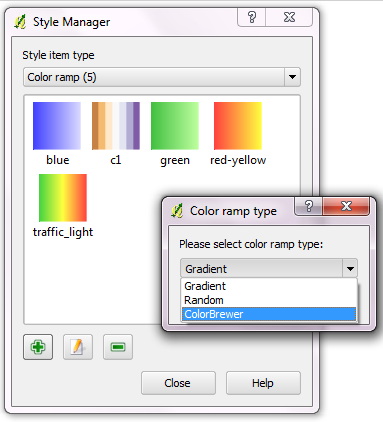
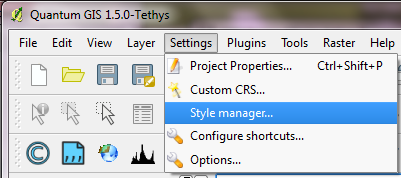
All styles: marker, line, fill and color ramps can be accessed via “Style manager”:

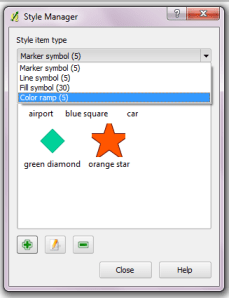
In Style Manager you can add, edit and delete styles:

When creating a new color ramp, you get to choose between “Gradient”, “Random” and finally “ColorBrewer” ramp type. (By the way: You can create multi-color color ramps if you choose “Gradient”.)

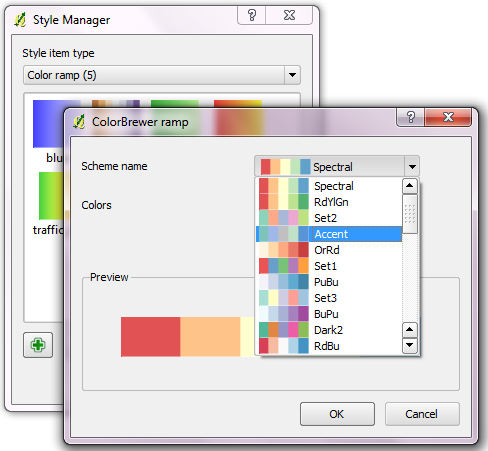
When creating a ColorBrewer ramp, you can choose from various schemes and define how many colors your ramp should contain:

I love these new ramps and I wish I’d have discovered them sooner :)

Enjoy the power of ColorBrewer and QGIS!

QGIS Mapserver is now in QGIS trunk. Check Linfiniti Geo Blog to learn how to set it up and just how powerful this new server is. We’re all looking forward to see how QGIS Mapserver performs compared to older projects like UMN Mapserver and Geoserver at the WMS Benchmarking in Barcelona.


FOSS4G 2010 conference in Barcelona is coming closer and closer. Have a look at this year’s presentations. Presentations are held on a variety of topics including:

Web Mapping

  • Web Mapping Performance Shootout
  • Web Map Printing with GeoExt
  • Printing in web mapping application: MapFish print module
  • GeoExt and MapFish Client components – how to migrate
  • Where’s MapFish going?
  • A typification of Open Source web mapping client software and frameworks
  • GeoServer CSS – Mapping in Style
  • GeoServer cartographic rendering: new features for map makers
  • Graphical style editing with Styler: Make a basemap without seeing SLD
  • WMS Inspector: a Firefox add-on with tools for working with Web Map Services
  • Performance and statistical analysis of WMS servers
  • Adding custom search engines to OpenLayers with OpenSearch ‘geo’
  • What You Type Is What You See: Comparing two web-based open source approaches to display the results of spatial SQL queries
  • OldMapsOnline.org: Open Source & Online Tools for Old Maps
  • OpenStreetMap-in-a-Box – A Ready-Made Highly Configurable Map Server
  • MapProxy -An accelerating proxy for web map services
  • TileSeeder; a new tile management tool
  • TileCache, GeowebCache and MapProxy – a technical and usability comparison
  • Developing Desktop-like Web GIS Applications with HTML and JavaScript
  • Squeeze: Configuring MapServer and KML to Get The Most Out Of Google Earth
  • PostLBS – Universal WebAPI Platform for Visualizing Geospatial Analysis–Routing, Geocoding, Thematic Mapping and More!
  • Implementing Open Source Tile Caching in a Large Scale US Army Project
  • OpenLayers’ Future
  • Performance Considerations In OpenLayers Based Web Mapping
  • Putting things together: Geonetwork opensource, OpenLayers, GeoExt and MapFish under the roof of Drupal CMS – Geoportal RO as an example
  • MapServer Project Status
  • Hidden features and useful tips for MapServer powerusers
  • Raster data support in GeoServer and GeoTools: recent achievements, unsolved issues and future developments

WPS

  • GeoServer WPS: an integrated, extensible processing service
  • 52º North WPS framework with ArcGIS geoprocessing support – Open Source solution meets closed source software
  • ZOO Project: The powerful WPS Platform
  • Compliance Testing of Open Source software for Web Processing Services
  • Introducing deegree 3 WPS
  • EnviModel: scientific workflows and WPS geoprocessing for climate change
  • Hybrid Cloud Computing for FOSS4G

Training & Education

  • Using Open Source Software in GIS Training and Education
  • Interactive METEOSAT: Educational platform for meteorological applications entirely developed with FLOSS software
  • Why Schools must use FOSS4G

Sensor Web

  • Building a New Generation of Sensor Web Implementations for Hydrology
  • Performance of the 52º North SOS in a real application environment
  • Comparison of SOS-Servers: 52°North, UMN and deegree
  • SOS vs. WFS – Coupling 52° North’s Sensor Observation Service and Geoserver‘s Web Feature Service
  • The New Time Series Toolbox – Next Generation of Sensor Web and Time Series Processing
  • istSOS: Sensor Observation Service in Python
  • How to Discover Sensors in the Sensor Web?

Misc

  • Mobile Augmented Reality using FOSS
  • Vertical Datums: Introduction and Software Review
  • Building a consistent and transparent legal and policy framework for spatial data
  • ecoRelevé: An open source response to the biodiversity crisis
  • GeoSocial, a tool for geospatial analysis and data mining of social networks
  • Real-time position analysis during soccer matches
  • Comparison of Open Source Virtual Globes
  • deegree project report: past, present, future
  • From the crowd sourcing to the institutional sourcing: a way to cooperate between regional and local administration
  • Gesopatial Desktop Comparison
  • Neo4j Spatial – backing a GIS with a true graph database
  • Bridging the Gap Between Open Source Tools and Proprietary Data Sources
  • Open source Geospatial Business Intelligence in action with GeoMondrian and SOLAPLayers!
  • Protect your GIS
  • Introducing OpenScales
  • OSSIM – advanced open source remote sensing
  • State of the art of FOSS4G for topology and network analysis
  • Bringing the raster processing algorithms of the Orfeo Toolbox Monteverdi in QGIS
  • A geospatial data collection system for organisations
  • GeoREST: Open Web Access to Public Geodata Based on Atom Publishing
  • Distributed Spatial Indexing in the Cloud
  • Integrating SEXTANTE and GRASS
  • GeoCat Bridge – One click data publishing
  • Semantic Web approach for thematic structuring of geographic objects
  • Semantic search in OGC Catalog Services for the Web
  • BeETLe project: a free geospatial ETL tool
  • GeoKettle: A powerful open source spatial ETL tool
  • Geomajas: new kid on the block

OSGeo

  • The State of OSGeo
  • International Collaboration on the OSGeo4W
  • OSGeo:Open Source Projects and Communities
  • The OGC and its participatory processes: OGCnetwork, open WG, regional Fora and the collaboration with OSGeo

Mobile & 3D GIS

Inspire & SDIs

  • OpenLayers: SOS and INSPIRE
  • State of Ingres geospatial 2010
  • INSPIRE Geoportal a platform for INSPiRE services
  • Implementing INSPIRE with FOSS4G: a Success Story
  • GeoNetwork opensource – The geospatial metadata catalogue
  • Implementation of ISO and OGC (INSPIRE) metadata standards – MEDARD (FOSS) metadata editor and Internet Geoinformation Metadata Platform (IPMGeo)
  • Authentication and authorization management to OGC services with GeoShield: improvements from FOSS4G 2009
  • License and Permission-based access to OGC Web Services with 52°North
  • Deploying and securing Spatial Data Infrastructures (SDI) with GISpatcher
  • Metadata Reloaded – How to profit from INSPIRE
  • GeoNode Architecture: Wrangling $100 million worth of open source software to make SDI building a walk in the park

PostGIS & PGRouting

  • Shortest path search for real road networks with pgRouting
  • An extension of PGRouting library functions for visibility-graph-based course calculations in a Vessel Traffic Management System (VTMS)
  • Tips for the PostGIS Power User
  • Running long and complex processes with PostGIS
  • PostGIS meets the third dimension
  • Introducing PostGIS WKT Raster: Seamless raster/vector operations in a spatial database
  • PostGIS WKT Raster. An Open Source alternative to Oracle GeoRaster
  • The State of PostGIS
  • Moving from Oracle/ArcGIS to PostGresql/PostGIS

Other Geodatabases

  • Geospatial Indexing with MongoDB
  • GeoCouch: A spatial index for CouchDB
  • Beyond PostGIS – New developments in Open Source Spatial Databases
  • SpatiaLite, the Shapefile of the future?

GIS Data

Applied GIS & Use Cases

  • A WebGIS application to monitor Road Trafic
  • GeoServer, GeoTools, GeoBatch: relying on the “usual suspects” for supporting operational Meteorology and Oceanography
  • Building the Digital Observatory for Protected Areas on an Open Source Framework
  • Open-source Earthquake and Hydrodynamic Modelling
  • Open Environmental Services Infrastructure
  • Case Study: Upgrading Guatemala’s SDI portal to a GeoNode
  • Proprietary to FOSS: MapServer as a key component in the map distribution infrastructure of the Norwegian SDI
  • Applied SDI in Germany – Complying with INSPIRE
  • Coming Full Circle: Archaeology and Open Source GIS, Past, Present and Future
  • Open Government, Open Data, Open Architecture and Open Source Software GIS Policy for U.S. Army Installation Management: 2010
  • Operational use of the Orfeo Tool Box for the Venus Mission
  • Enhancing the European Forest Fire Information System (EFFIS) with Open Source Software
  • ArchaeoloGIS: OSGIS in Archaeological Research
  • The World Meteorological Oganization Information System
  • Introduction of flood evacuation route search system using QGIS, PostGIS, GRASS and PgRouting

This year’s Google Summer of Code project for QGIS “QGIS on Steroids” has come to an successful end. The resulting improvements are currently available through http://svn.osgeo.org/qgis/branches/threading-branch/ and will be available in trunk after more testing.

Read Martin’s full report on QGIS wiki.