Archive

Tag Archives: Trajectools

The latest releases of MovingPandas and Trajectools come with many “under the hood” changes that aim to make your movement analytics faster:

  1. Instead of immediately creating a GeoPandas GeoDataFrame and populating the geometry column with Point objects, MovingPandas now has “lazy geometry column creation” that holds off on this operation until / if the geometries are actually needed. This way, for many operations, no geometry objects have to be generated at all.
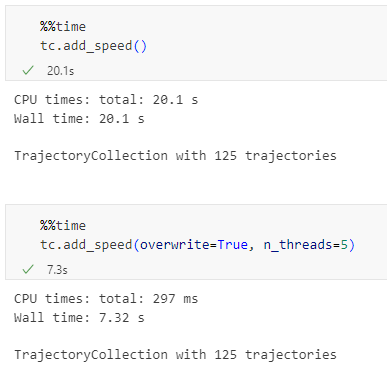
  2. MovingPandas TrajectorySplitters now support parallel processing and Trajectools uses parallel processing whenever available (e.g. for adding speed & direction metrics, detecting stops, splitting trajectories).
  3. When a minimum length is specified for trajectories, MovingPandas now avoids computing the total trajectory length and, instead, immediately stops once the threshold value has been reached (“early skip”).
  4. Trajectools now offers the option to skip computation of movement metrics (speed & direction). This way, we can skip unnecessary computations and leverage the lazy geometry column creation, wherever applicable.

Let’s have a look at some example performance measurements!

Example 1: MovingPandas ValueChangeSplitter

The ValueChangeSplitter splits trajectories when it detects a value change in the specified column. This is useful, for example, to split up public trajectories that contain a “next_stop” column.

The following graph shows ValueChangeSplitter runtimes for different minimum trajectory length settings (from 0 to 1km, 100km, and 10,000km):

We see that the new, lazy geometry column initialization outperforms the old original code in all cases (e.g. 57% runtime reduction for 1km), except for the worst-case scenario, when the original implementation discards all trajectories as too short right from the start. (For most use cases, min_length will be set to rather small values to avoid creation of undesired short trajectory fragments, similar to sliver polygons in classic geometry operations.)

Additionally, we can engage multiprocessing by setting the n_processes parameter, e.g. to the number of CPUs to achieve further speedup:

Example 2: Trajectools

By applying all above-mentioned speedup techniques, Trajectools is now considerably faster. For example, the following runtime reductions can be achieved by deactivating the “Add movement metrics (speed, direction)” option in the algorithm dialog:

  • Create trajectories: 62%
  • Spatiotemporal generalization (TDTR): 78%
  • Temporal generalization: 81%
  • Split trajectories at stops: 53%

I have also updated the default trajectory points output style. It now uses a graduated renderer to visualize the speed values (if they have been calculated) instead of the previously used data-defined override. This makes the style faster to customize and provides a user-friendly legend:

For more infos, have a look at:

Enjoy the latest performance increases!

If you downloaded Trajectools 2.1 and ran into troubles due to the introduced scikit-mobility and gtfs_functions dependencies, please update to Trajectools 2.2.

This new version makes it easier to set up Trajectools since MovingPandas is pip-installable on most systems nowadays and scikit-mobility and gtfs_functions are now truly optional dependencies. If you don’t install them, you simply will not see the extra algorithms they add:

If you encounter any other issues with Trajectools or have questions regarding its usage, please let me know in the Trajectools Discussions on Github.

Today marks the 2.1 release of Trajectools for QGIS. This release adds multiple new algorithms and improvements. Since some improvements involve upstream MovingPandas functionality, I recommend to also update MovingPandas while you’re at it.

If you have installed QGIS and MovingPandas via conda / mamba, you can simply:

conda activate qgis
mamba install movingpandas=0.18

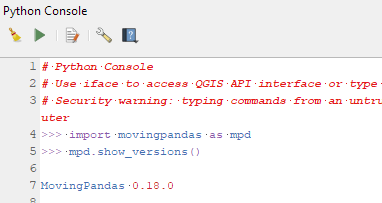
Afterwards, you can check that the library was correctly installed using:

import movingpandas as mpd
mpd.show_versions()

Trajectools 2.1

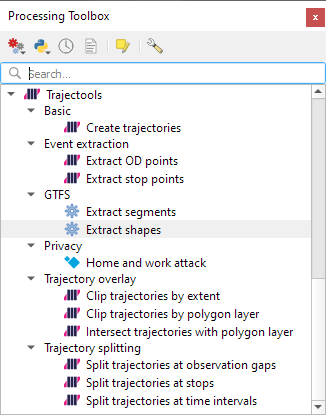
The new Trajectools algorithms are:

  • Trajectory overlay — Intersect trajectories with polygon layer
  • Privacy — Home work attack (requires scikit-mobility)
    • This algorithm determines how easy it is to identify an individual in a dataset. In a home and work attack the adversary knows the coordinates of the two locations most frequently visited by an individual.
  • GTFS — Extract segments (requires gtfs_functions)
  • GTFS — Extract shapes (requires gtfs_functions)

Furthermore, we have fixed issue with previously ignored minimum trajectory length settings.

Scikit-mobility and gtfs_functions are optional dependencies. You do not need to install them, if you do not want to use the corresponding algorithms. In any case, they can be installed using mamba and pip:

mamba install scikit-mobility
pip install gtfs_functions

MovingPandas 0.18

This release adds multiple new features, including

  • Method chaining support for add_speed(), add_direction(), and other functions
  • New TrajectoryCollection.get_trajectories(obj_id) function
  • New trajectory splitter based on heading angle
  • New TrajectoryCollection.intersection(feature) function
  • New plotting function hvplot_pts()
  • Faster TrajectoryCollection operations through multi-threading
  • Added moving object weights support to trajectory aggregator

For the full change log, check out the release page.

The Trajectools toolbox has continued growing:

I’m continuously testing the algorithms integrated so far to see if they work as GIS users would expect and can to ensure that they can be integrated in Processing model seamlessly.

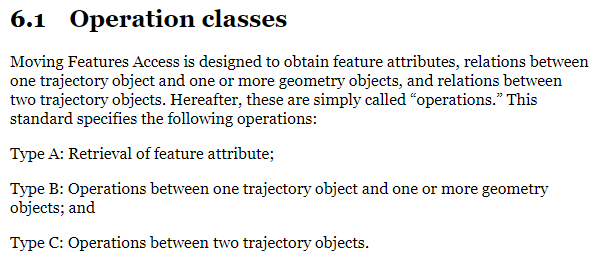
Because naming things is tricky, I’m currently struggling with how to best group the toolbox algorithms into meaningful categories. I looked into the categories mentioned in OGC Moving Features Access but honestly found them kind of lacking:

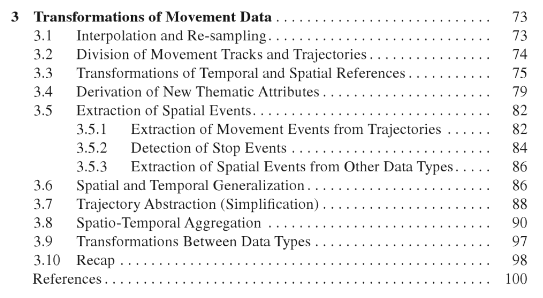
Andrienko et al.’s book “Visual Analytics of Movement” comes closer to what I’m looking for:

… but I’m not convinced yet. So take the above listed three categories with a grain of salt. Those may change before the release. (Any inputs / feedback / recommendation welcome!)

Let me close this quick status update with a screencast showcasing stop detection in AIS data, featuring the recently added trajectory styling using interpolated lines:

While Trajectools is getting ready for its 2.0 release, you can get the current development version directly from https://github.com/movingpandas/qgis-processing-trajectory.