Archive

GIS

Today, I’ve compiled a short video showcasing one of the possible uses of Time Manager plugin: Storm tracking. (Storm data can be downloaded from www.nhc.noaa.gov.)

Point size shows storm class, labels read maximum speed in mph.

If you are using Time Manager for your work, I’d love to hear about it.

If you are planning to tweak the labels in SVG output from QGIS, you should use the old labeling engine. Labels create with the old engine are written into the SVG file as text objects whereas labels from the new engine end up as paths for some reason.

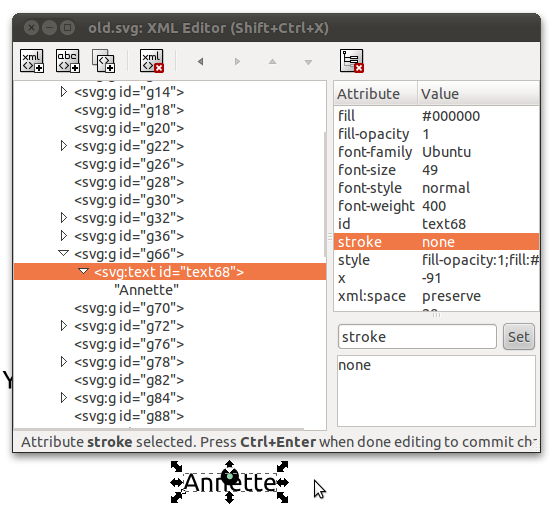
Let’s see how it works using the climate Shapefile from QGIS sample data. I just created an empty map, loaded the points and labeled them before exporting the map to SVG using Print Composer. Now, we can manipulate the SVG file in Inkscape: Select one of the labels and and start the XML Editor (Edit menu – XML Editor or through the toolbar button).

Find the "XML tree" button for full control of the labels

If you selected a label before opening XML Editor, one of the entires in the tree should be highlighted. Expanding the element reveals that it’s a text featuring a series of attributes QGIS exported. From here, you can change both the looks and the text of all labels in your map. Of course, you are not limited to the XML Editor but can change to the GUI – which is certainly recommended for experimenting with all the different settings.

Here you have full control over how the label looks like

Today, I’ve been experimenting with data from OpenFlights.org. They offer airport, airline and route data for download. The first idea that came to mind was to connect airports on a shared route by lines. This kind of visualization just looks much nicer if the connections are curved instead of simple straight lines.

Luckily, that’s pretty easy to do using PostGIS. After loading airport positions and route data, we can create the connection lines like this (based on [postgis-users] Great circle as a linestring):

UPDATE experimental.airroutes
SET the_geom = 
(SELECT ST_Transform(ST_Segmentize(ST_MakeLine(
       ST_Transform(a.the_geom, 953027),
       ST_Transform(b.the_geom, 953027)
     ), 100000 ), 4326 ) 
 FROM experimental.airports a, experimental.airports b
 WHERE a.id = airroutes.source_id  
   AND b.id = airroutes.dest_id
);

The CRS used in the query is not available in PostGIS by default. You can add it like this (source: spatialreference.org):

INSERT into spatial_ref_sys (srid, auth_name, auth_srid, proj4text, srtext) values ( 953027, 'esri', 53027, '+proj=eqdc +lat_0=0 +lon_0=0 +lat_1=60 +lat_2=60 +x_0=0 +y_0=0 +a=6371000 +b=6371000 +units=m +no_defs ', 'PROJCS["Sphere_Equidistant_Conic",GEOGCS["GCS_Sphere",DATUM["Not_specified_based_on_Authalic_Sphere",SPHEROID["Sphere",6371000,0]],PRIMEM["Greenwich",0],UNIT["Degree",0.017453292519943295]],PROJECTION["Equidistant_Conic"],PARAMETER["False_Easting",0],PARAMETER["False_Northing",0],PARAMETER["Central_Meridian",0],PARAMETER["Standard_Parallel_1",60],PARAMETER["Standard_Parallel_2",60],PARAMETER["Latitude_Of_Origin",0],UNIT["Meter",1],AUTHORITY["EPSG","53027"]]');

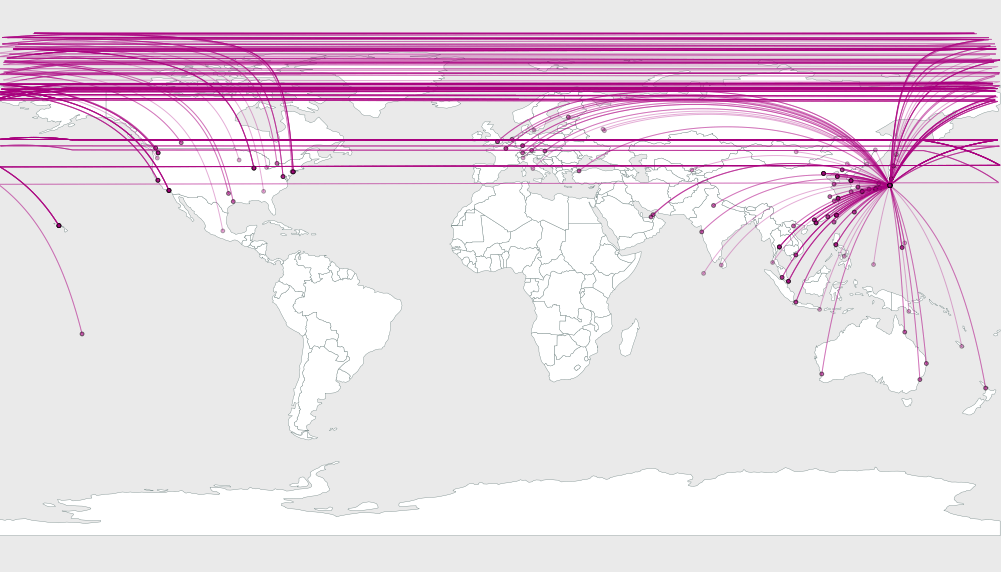
This is an example visualization (done in QGIS) showing only flight routes starting from Vienna International Airport:

Flight routes from Vienna International

Connections crossing the date line are currently more problematic. Lines would have to be split, otherwise this is what you’ll get:

Date line trouble

Do you need to create a table with a geometry column in PostGIS from scratch?
Can’t remember the syntax of AddGeometryColumn(varchar catalog_name, varchar schema_name, varchar table_name, varchar column_name, integer srid, varchar type, integer dimension)? I can’t. ;)

Let’s make our lives easier: QGIS PostGIS Manager offers a convenient GUI for creating tables with geometry columns:

PostGIS Manager Create Table dialog

The dialog works a lot like what you’re probably used to in pgAdmin – with the added nicety of supporting Geometry columns.

In my opinion, this is the fastest way so far to create a spatially enabled table. It provides a much better user experience than telling users (especially new ones) to use AddGeometryColumn(…

QGIS styling options have advanced a lot in the last releases. But there’s always something more we would love to have … Greedy users!

Inkscape and other graphics programs can do it: Gradient fills.

Inspired by a question on gis.stackexchange, I tried to create something as close to a gradient fill as possible.

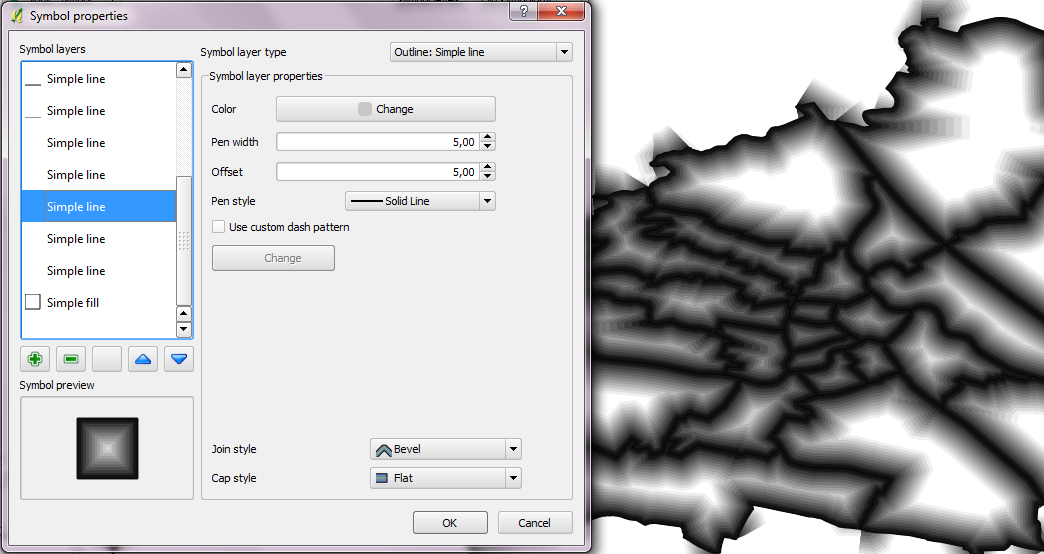
What I came up with is a symbol consisting out of multiple stacked “simple line” layers. The top-most layer is the dark outer border and every following layer is getting lighter and growing towards the center of the polygon (using a positive offset value). Important options are flat cap styles for all line layers and – of course – enabled symbol levels.
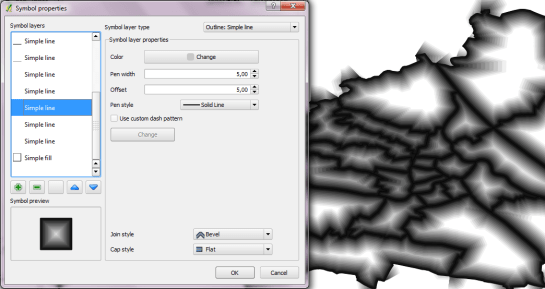
A "gradient" fill in QGIS

As you can see, the gradient looks quite fine inside the polygons. For the edges, it would be necessary to add a mask hiding the unclean rendering. Or maybe there is another solution which I just couldn’t think of?
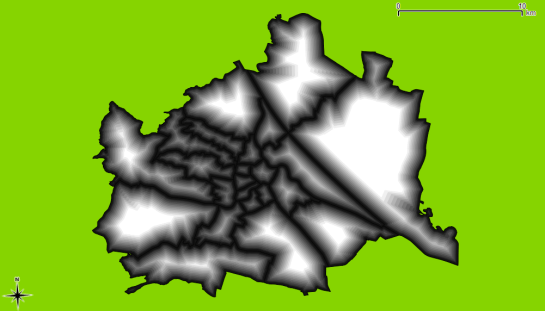
Nicer map using a mask

This is the symbol source if you want to try it. Paste it into your symbology-ng-style.xml document.

    <symbol outputUnit="MM" alpha="1" type="fill" name="gradient">
      <layer pass="0" class="SimpleFill" locked="0">
        <prop k="color" v="255,255,255,255"/>
        <prop k="color_border" v="0,0,0,255"/>
        <prop k="offset" v="0,0"/>
        <prop k="style" v="solid"/>
        <prop k="style_border" v="solid"/>
        <prop k="width_border" v="1"/>
      </layer>
      <layer pass="0" class="SimpleLine" locked="0">
        <prop k="capstyle" v="flat"/>
        <prop k="color" v="240,240,240,255"/>
        <prop k="customdash" v="5;2"/>
        <prop k="joinstyle" v="bevel"/>
        <prop k="offset" v="6"/>
        <prop k="penstyle" v="solid"/>
        <prop k="use_custom_dash" v="0"/>
        <prop k="width" v="6"/>
      </layer>
      <layer pass="0" class="SimpleLine" locked="0">
        <prop k="capstyle" v="flat"/>
        <prop k="color" v="220,220,220,255"/>
        <prop k="customdash" v="5;2"/>
        <prop k="joinstyle" v="bevel"/>
        <prop k="offset" v="5.5"/>
        <prop k="penstyle" v="solid"/>
        <prop k="use_custom_dash" v="0"/>
        <prop k="width" v="5.5"/>
      </layer>
      <layer pass="0" class="SimpleLine" locked="0">
        <prop k="capstyle" v="flat"/>
        <prop k="color" v="200,200,200,255"/>
        <prop k="customdash" v="5;2"/>
        <prop k="joinstyle" v="bevel"/>
        <prop k="offset" v="5"/>
        <prop k="penstyle" v="solid"/>
        <prop k="use_custom_dash" v="0"/>
        <prop k="width" v="5"/>
      </layer>
      <layer pass="0" class="SimpleLine" locked="0">
        <prop k="capstyle" v="flat"/>
        <prop k="color" v="180,180,180,255"/>
        <prop k="customdash" v="5;2"/>
        <prop k="joinstyle" v="bevel"/>
        <prop k="offset" v="4.5"/>
        <prop k="penstyle" v="solid"/>
        <prop k="use_custom_dash" v="0"/>
        <prop k="width" v="4.5"/>
      </layer>
      <layer pass="0" class="SimpleLine" locked="0">
        <prop k="capstyle" v="flat"/>
        <prop k="color" v="160,160,160,255"/>
        <prop k="customdash" v="5;2"/>
        <prop k="joinstyle" v="bevel"/>
        <prop k="offset" v="4"/>
        <prop k="penstyle" v="solid"/>
        <prop k="use_custom_dash" v="0"/>
        <prop k="width" v="4"/>
      </layer>
      <layer pass="0" class="SimpleLine" locked="0">
        <prop k="capstyle" v="flat"/>
        <prop k="color" v="140,140,140,255"/>
        <prop k="customdash" v="5;2"/>
        <prop k="joinstyle" v="bevel"/>
        <prop k="offset" v="3.5"/>
        <prop k="penstyle" v="solid"/>
        <prop k="use_custom_dash" v="0"/>
        <prop k="width" v="3.5"/>
      </layer>
      <layer pass="0" class="SimpleLine" locked="0">
        <prop k="capstyle" v="flat"/>
        <prop k="color" v="120,120,120,255"/>
        <prop k="customdash" v="5;2"/>
        <prop k="joinstyle" v="bevel"/>
        <prop k="offset" v="3"/>
        <prop k="penstyle" v="solid"/>
        <prop k="use_custom_dash" v="0"/>
        <prop k="width" v="3"/>
      </layer>
      <layer pass="0" class="SimpleLine" locked="0">
        <prop k="capstyle" v="flat"/>
        <prop k="color" v="100,100,100,255"/>
        <prop k="customdash" v="5;2"/>
        <prop k="joinstyle" v="bevel"/>
        <prop k="offset" v="2.5"/>
        <prop k="penstyle" v="solid"/>
        <prop k="use_custom_dash" v="0"/>
        <prop k="width" v="2.5"/>
      </layer>
      <layer pass="0" class="SimpleLine" locked="0">
        <prop k="capstyle" v="flat"/>
        <prop k="color" v="80,80,80,255"/>
        <prop k="customdash" v="5;2"/>
        <prop k="joinstyle" v="bevel"/>
        <prop k="offset" v="2"/>
        <prop k="penstyle" v="solid"/>
        <prop k="use_custom_dash" v="0"/>
        <prop k="width" v="2"/>
      </layer>
      <layer pass="1" class="SimpleLine" locked="0">
        <prop k="capstyle" v="flat"/>
        <prop k="color" v="60,60,60,255"/>
        <prop k="customdash" v="5;2"/>
        <prop k="joinstyle" v="bevel"/>
        <prop k="offset" v="1.5"/>
        <prop k="penstyle" v="solid"/>
        <prop k="use_custom_dash" v="0"/>
        <prop k="width" v="1.5"/>
      </layer>
      <layer pass="2" class="SimpleLine" locked="0">
        <prop k="capstyle" v="flat"/>
        <prop k="color" v="40,40,40,255"/>
        <prop k="customdash" v="5;2"/>
        <prop k="joinstyle" v="bevel"/>
        <prop k="offset" v="1"/>
        <prop k="penstyle" v="solid"/>
        <prop k="use_custom_dash" v="0"/>
        <prop k="width" v="1"/>
      </layer>
      <layer pass="3" class="SimpleLine" locked="0">
        <prop k="capstyle" v="flat"/>
        <prop k="color" v="20,20,20,255"/>
        <prop k="customdash" v="5;2"/>
        <prop k="joinstyle" v="bevel"/>
        <prop k="offset" v="0.5"/>
        <prop k="penstyle" v="solid"/>
        <prop k="use_custom_dash" v="0"/>
        <prop k="width" v="1"/>
      </layer>
      <layer pass="4" class="SimpleLine" locked="0">
        <prop k="capstyle" v="flat"/>
        <prop k="color" v="10,10,10,255"/>
        <prop k="customdash" v="5;2"/>
        <prop k="joinstyle" v="bevel"/>
        <prop k="offset" v="0"/>
        <prop k="penstyle" v="solid"/>
        <prop k="use_custom_dash" v="0"/>
        <prop k="width" v="0.5"/>
      </layer>
    </symbol>

This is something I have been wanting to do for a long time: map which areas of Vienna have fast access to a certain kind of infrastructure. Now, I finally found time and data to perform this analysis. Data used is OSM road data (Cloudmade shapefile) for Austria and metro station coordinates for Vienna by Max Kossatz and Robert Harm.

Before importing the OSM roads into PostGIS, I cut out my area of interest and created a clean topology using GRASS v.clean.break. Once loaded into the database, assign_vertex_id() function does the rest and the network is ready for routing and distance calculations.
For the metro stations, I calculated the nearest network node using George MacKerron’s Nearest Neighbor function.

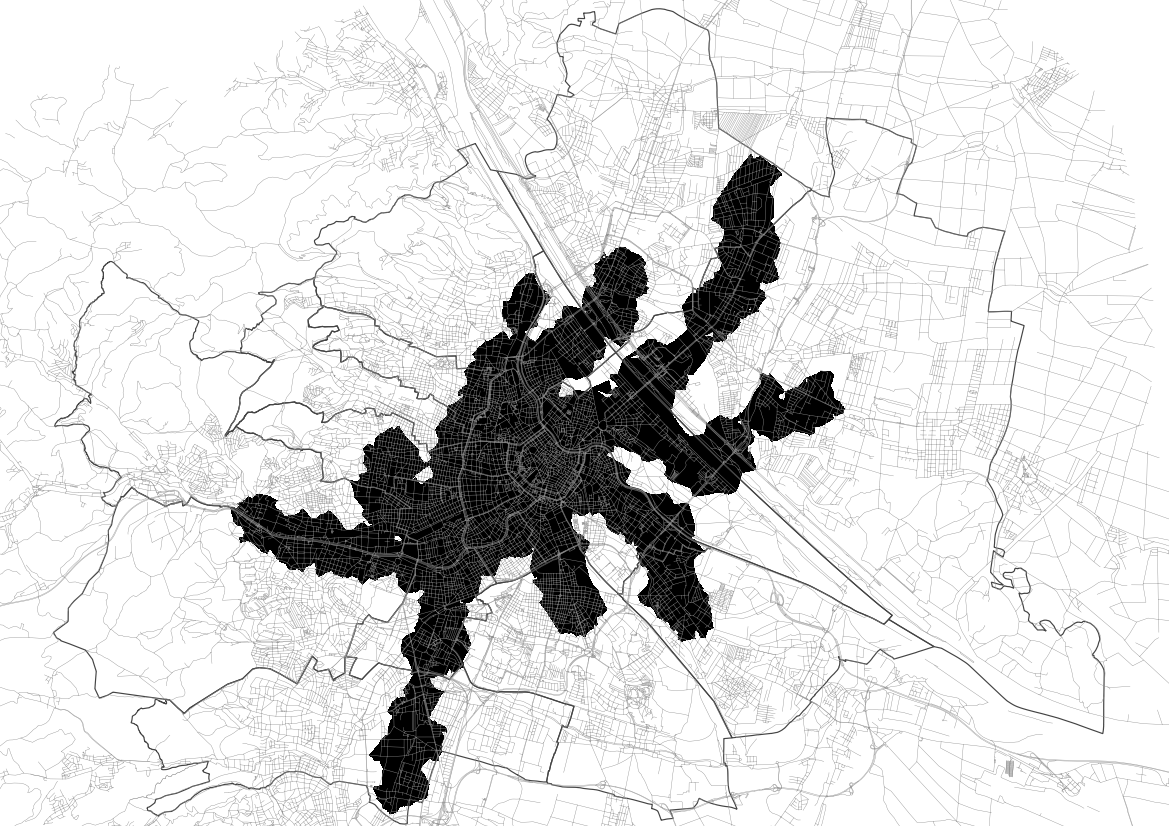
Catchments were calculated using driving_distance() function. It returns distance to a given metro station for all network nodes (up to a maximum distance). The result can be interpolated to show e.g. which areas are at most 1 km away from any metro station.

1 km catchments around metro stations in Vienna

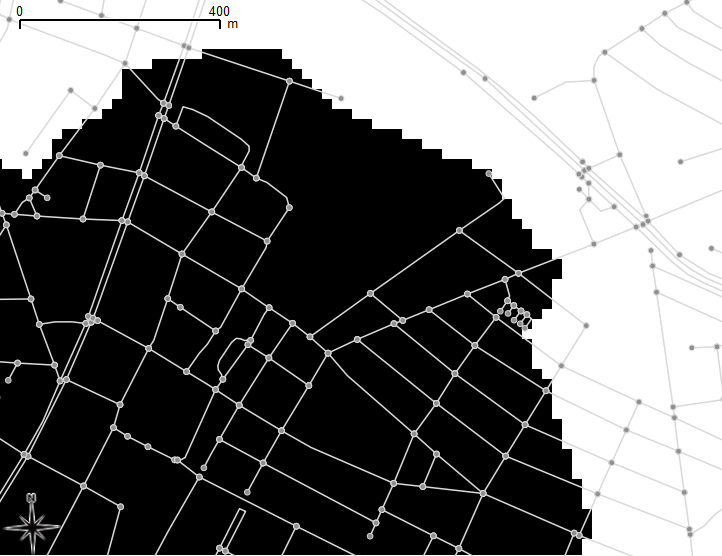
Close-up look at the 1 km catchment zone border

Once set up, performing this analysis is reasonably fast. Instead of metro stations, any other infrastructure coverage can be analyzed easily. I could imagine this being really useful when looking for a new flat: “Find me an area close to work, a metro station and a highschool.”

The next great thing would be to have all data for calculation of transit travel times too. Yes, I’m looking at you Wiener Linien!

Want to finally try QGIS Server on your Windows system? Thankfully, Till Adams has written a new HowTo for QGIS Server on Windows. Till shows how to install OSGeo4W version and how to get it running.

If you first want to see what QGIS Server and QGIS Webclient can do, check Webgis-Uster homepage by Andreas Neumann.

Vienna’s Open Government Data initiative is publishing an increasing amount of Geodata and the best thing is: They’re publishing it via open standardized services! Both WMS and WFS are available and ready to be used in QGIS.

Let’s see how we can use the data available through their WFS using the district information layer “Bezirksgrenzen” as an example. The page lists a GML and a GeoJSON version of WFS. For now, we’ll use GeoJSON.

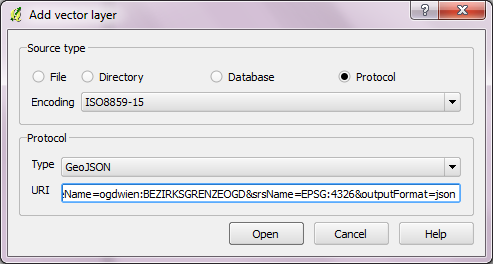
In QGIS, the layer can be loaded using “Add vector layer” – “Protocol” and inserting the GeoJSON url there. The encoding should be changed to ISO8859-15 to account for “Umlaute”.

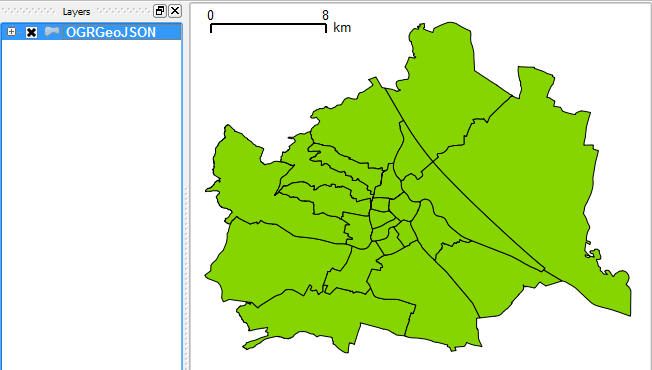
The loaded GeoJSON layer "Bezirksgrenzen"

Now, we have geodata. Let’s add some attribute data too! Attribute data is available in CSV format. After downloading e.g. some information on the district population, check the file content and remove excessive header lines so that there is only one header line containing attribute names left. Then, you can load the CSV file into QGIS too (“Add vector layer”).

Last step: Joining geodata and attribute data! Go to the vector layer’s properties – Join tab and add the following join relation:

Joining GeoJSON and attribute layer

Now, the attribute table of the vector layer contains the additional CSV attributes – ready for further analysis. If you want to classify based on numerical CSV attributes, you’ll have to create a .csvt file first otherwise all fields are interpreted as texts.

Works great. Thumbs up for this great initiative!

QGIS 1.7 has landed. After some delays due to a major infrastructure overhaul, a new version of QGIS is available for download. For a list of what’s new in 1.7 check the release announcement.

QGIS trunk now comes with a separate tool called “QGIS Browser”. It enables the user to browse through all spatial data files on the system as well as all WMS configured in QGIS. Both files and WMS layers are listed in a tree widget on the left side while metadata, attributes and a preview can be seen on the right.

WMS preview in QGIS Browser

This is a great way for example to check through all layers of a WMS fast and without having to go through the “Add WMS Layer” dialog in QGIS all the time.